
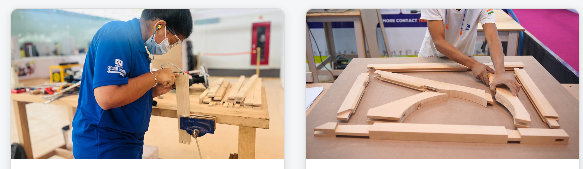
The Talent Crunch: Bridging Traditional Skills with the Future of Furniture
The furniture industry is changing rapidly. As we move towards modular manufacturing, automation, CAD/CAM and digital design, one question becomes increasingly important: Where does the carpenter fit into the future?
Last week, while teaching Modular Furniture Design at a girls’ college, a student asked me: “Sir, if the entire industry is moving towards modular furniture, will the role of carpenters disappear?”
My answer was simple: “The carpenter will not disappear. The carpenter will evolve.”
The carpenter of tomorrow will be more than someone who works with a hammer and saw. He will become a Furniture Technician, Installer and Craftsman—someone who understands materials, hardware, technical drawings, machines, precision and, most importantly, how to make factory-made furniture work perfectly in a real home.
The Future is Hybrid
The best furniture solutions will increasingly combine the precision and efficiency of modular manufacturing with the skill and adaptability of craftsmanship.
A modular product may be 80% standardised, but the remaining 20% is often where the real challenge lies—the uneven wall, imperfect floor, unusual corner, customised detail or special client requirement.
That is where human skill becomes invaluable.
A factory can manufacture a wardrobe with extraordinary precision, but when it reaches a customer’s home, someone still needs to measure, adjust, install, troubleshoot and deliver the final finish.
That person is the modern furniture technician.
Earlier, a carpenter could create an entire piece of furniture using hand tools. Today, he may work with CNC-machined panels, precision hardware, technical drawings and specialised installation tools.
He has not become less important. He has become more skilled.
I often tell students: “Don’t worry about the carpenter’s job disappearing. Worry about how we can make our carpenters skilled enough to thrive in the evolving industry.”
Building the Bridge Between Education and Industry
This brings us to one of the biggest challenges facing the industry—the talent crunch.
Fewer young people are choosing blue-collar professions such as carpentry, furniture fitting, installation and shop-floor production. Many perceive these careers as physically demanding, low-status and offering limited growth.
We need to change that perception by transforming traditional jobs into modern, technologydriven careers with dignity, better earning potential and clear career progression.
Every furniture manufacturing unit can become a Skill Academy, offering structured apprenticeships and vocational training in:
* Furniture manufacturing and installation
* CAD/CAM and CNC operations
* Hardware and fittings * Quality control and production planning
* Site measurement and installation
* Furniture design and detailing
* Sales and customer handling
This can create a strong bridge between education and employment.
We Need to Look for Talent Differently
Talent is everywhere. Sometimes, we simply don’t look in the right places.
Manufacturers can identify promising students from ITIs, schools and colleges, connect with local communities and even work with village leaders to discover young people with the aptitude and interest to learn.
The objective should not simply be to find workers.
It should be to discover potential and build careers.
And why wait until student’s graduate?
Furniture companies can spend even one or two hours every month engaging with nearby schools and colleges. A factory visit, a demonstration of CNC technology or an introduction to furniture design can open a completely new career path for a young student.
Industry exposure can change lives.
We Also Need Better Sales Professionals.
The talent requirement is not limited to manufacturing.
One thing which we should not forget is DIY, today it may not be much since labour is cheap in Our country, but in a few years hiring carpenters would become more expensive like Europe, US and some Asian markets like Singapore, Middle East and Hong Kong etc.
However, the furniture industry will still need sales professionals who understand design, materials, products, customer psychology and technology.
A modern furniture salesperson is not simply selling a product. They are selling a lifestyle, solving space-related problems, understanding aspirations and often coordinating between design, production and installation.
Furniture companies should therefore also engage with MBA and management institutes and present furniture as a professional, growing and exciting career opportunity.
Government + Industry + Skill Councils
We don’t have to do this alone.
Organisations such as the Furniture and Fittings Skill Council of India (FFSC) and AFMT (Association of Furniture manufacturer and Traders), along with government and other skill development organisations, can help create structured training programmes, certification and career pathways.
But this will succeed only through collaboration.
Manufacturers + Designers + Educational Institutions + Skill Councils + Government must work together to create a strong Furniture Industry Talent Pipeline.
If every furniture manufacturer adopts even one apprentice, every factory opens its doors to students, and industry professionals dedicate time to mentoring young talent, we can transform the talent landscape of Indian furniture.
Talent is not scarce. Structured opportunity and development are.
Let us stop waiting for skilled manpower to arrive.
Let us start creating it.